
Shoreline & Rip Rap Erosion Control Fabric
Pro Fabric Supply offers a wide variety of fabric sizes for shoreline and erosion control applications. Heavier-weight non-woven needle-punched fabrics let water drain while holding back sand, silt, and soil — the key to resisting shoreline erosion under rip rap.
- Heavier 8–16 oz non-woven, ideal for shorelines and rip rap walls
- Lets water pass through while holding back sand, silt, and soil
- High strength resists tearing under heavy rock and boulders
- Needle-punched for durability in demanding environments

Non-Woven Fabric & Rip Rap For Shoreline Erosion Control
The main benefit of using a non-woven geotextile fabric is its ability to let water pass through and drain while still holding back sand, silt, and soil. That capability is vital when you're fighting erosion. Many shorefront homeowners and contractors are looking for a way to slow shoreline erosion, and below we cover why non-woven fabric is a strong choice underneath shoreline rip rap and how it helps.
Rip rap on shorelines refers to the assortment of stone used to thwart the erosion caused by waves and weather. In general, there are two main kinds:
- Graded rip rap is a mixture of different stone sizes, ranging from smaller rock up to larger boulders.
- Uniform rip rap is exactly what the name implies — all stones are roughly the same size.
See Shoreline Fabric In Action

Which Kind Of Rip Rap Should I Use On My Shoreline?
For most applications, graded rip rap is preferable to uniform rip rap, for a couple of reasons. First, it's easier to place a variety of stones in an area than to line up a set size of larger boulders in a specific spot.
Graded rip rap lets the installer set larger cornerstone boulders in strategic places and then fill in the rest with whatever stone is on hand. That makes installation much easier with a machine or bucket, with no need to worry about exact sizing. The mix of sizes also increases the resilience of your wall against hard waves and storms — an almost self-healing quality, where smaller stones shift into the gaps between the larger ones and fill the cracks.
When graded rip rap isn't practical, uniform will work fine for most applications. Same-size stone can make placement easy if the stone is smaller; if the stones are closer to boulder size, proper placement takes more time. Smaller uniform stone can also wash out and move around more easily in a storm or coastal setting.
What Are The Classifications Of Shoreline Rip Rap?
The table below helps explain the various class or type sizing that contractors and engineers use when discussing rip rap stone.
| Riprap Class | Weight (lbs.) | Mean Spherical Diameter (ft.) |
|---|---|---|
| Class AI | 25 | 0.9 |
| Class I | 50 | 1.1 |
| Class II | 150 | 1.6 |
| Class III | 500 | 2.2 |
| Type I | 1,500 | 2.8 |
| Type II | 6,000 | 4.5 |
The exact sizing required for a particular application can be addressed by a project engineer or seasoned contractor, who will typically take environmental needs into consideration. A general guideline for sizing: the minimum thickness of the riprap layer should be 2 times the maximum stone diameter, but not less than 6 inches.
Rip rap sizing chart and class information found in STD & SPEC 3.19 from the State of Virginia on erosion control and the use of rip rap.
When Should Geotextile Filter Fabric Be Used For Shoreline Applications?
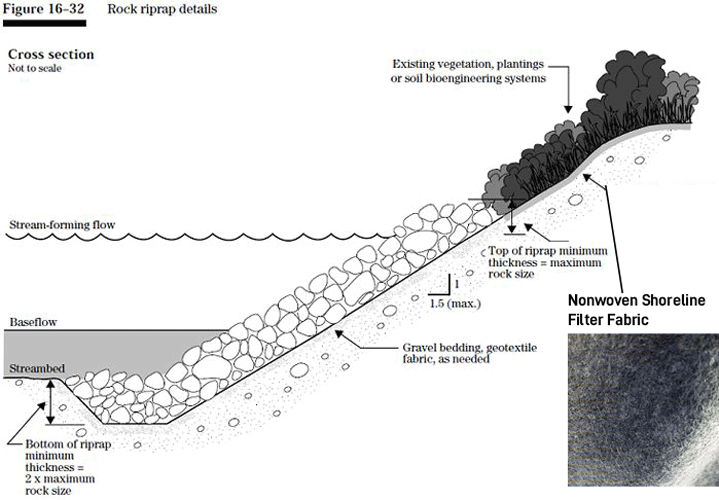
Erosion control fabric should be used to prevent the soil beneath it from washing away or migrating up through the rip rap.
Fabric can be used in situations where the slope is at a 1.5:1 grade or less — it isn't recommended on steeper slopes than that. If your project has a steeper slope, speak with a local engineer or contractor to better understand what's appropriate for your project.
What Kind Of Erosion Control Fabric Should Be Used For Shoreline Rip Rap?
We recommend a heavier-weight 8–16 oz non-woven needle-punched fabric for shoreline rip rap applications. This fabric is measured in weight per square yard (ounces), and a shoreline erosion control project would likely require fabric in the 10 oz to 16 oz weight range. The heavier fabrics provide more strength and are less likely to tear when large Class II or Class III boulders are placed on them.
Be sure to consult your local project engineer or construction professional about the rock sizing and the particular materials required.
Not sure which weight you need?
Answer a few quick questions and our Geotextile Fabric Selector will point you to the right shoreline fabric for your project.


