
Geotextile Drainage Fabric: Every Application Explained
Seven drainage fabric applications fully explained — what the fabric does, which weight to use, how to configure it, and what spec matters most for each type of drainage system
1. Residential French Drain: Sandy or Loamy Soil
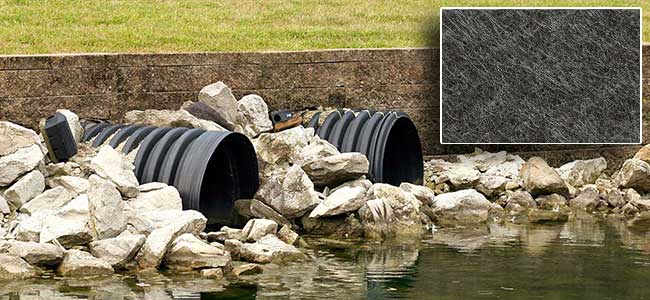
A French drain is a perforated pipe embedded in aggregate and covered with soil, designed to intercept and redirect groundwater or surface water away from foundations, basements, and low-lying areas. In sandy or loamy soil, the primary risk is fine sand and silt particles migrating into the clean aggregate surrounding the pipe, gradually filling the void space and reducing flow capacity.
What the Fabric Does
Non-woven geotextile fabric wraps the aggregate-and-pipe assembly, creating a permeable filter layer that allows water to enter freely from the surrounding soil while physically blocking fine particles from entering. The fabric's three-dimensional fiber matrix creates variable pore sizes that promote "bridging" — a phenomenon where fine particles form a stable arch across the fabric opening instead of passing through.
Correct Weight: 4oz
For sandy loam, sandy soil, and silty loam soil with D85 greater than 0.1 mm (most residential soils), 4oz non-woven geotextile with AOS of US No. 40 to No. 70 provides adequate filtration with high permittivity. The higher permittivity of 4oz fabric (typically 1.0 to 2.0 sec⁻¹) ensures water flows through rapidly without backing up, even during heavy rain events.
Installation Configuration
Line the trench walls and bottom with fabric (fabric extends up both sides of the trench). Place aggregate to a depth of 2 to 3 inches. Lay perforated pipe with holes facing down. Fill aggregate around and above pipe. Fold fabric over the top of the aggregate with minimum 12-inch overlap. Backfill with native soil or clean fill.
2. French Drain: Clay Soil
Clay soil presents a different filtration challenge than sand. Clay particles are extremely fine — often less than 0.002 mm — and clay soils behave cohesively. When disturbed, clay slakes into individual particles that can pass through fabric openings designed for sandy soil. If those particles migrate into the drain aggregate, they create a "clay cake" on the fabric surface that progressively reduces permeability.
What the Fabric Does
In clay soil, the fabric serves both as a filtration layer and as a physical barrier that promotes stable soil bridging. The finer AOS of heavier non-woven fabric creates smaller openings that force clay particles to bridge rather than pass through, forming a stable filter cake on the upstream face of the fabric that itself acts as a secondary filter without completely blocking water flow.
Correct Weight: 6oz
For clay and silty clay soil, 6oz non-woven geotextile is the preferred weight. The finer AOS (US No. 50 to No. 80 range) is more appropriate for the fine particle distribution of clay soils. Permittivity of 0.5 to 1.0 sec⁻¹ for 6oz fabric remains adequate for most residential drainage flow rates.
Key Spec for Clay Soil
In clay soil, Gradient Ratio (GR, ASTM D5101) — which measures clogging tendency — becomes important. Select fabric with a GR below 3 under the applicable soil test. For most residential clay drain projects, a 6oz non-woven geotextile from a quality manufacturer will meet this requirement, but confirming with supplier data is wise for long-term drainage systems.
3. Retaining Wall Drainage
Retaining walls hold back soil and are subjected to the hydrostatic pressure of water-saturated backfill. Without adequate drainage behind the wall, water pressure can increase by 50 to 100 percent above the design earth pressure, leading to wall movement, cracking, or failure. A drainage aggregate column with geotextile filtration is the primary defense against hydrostatic buildup.
What the Fabric Does
Geotextile fabric lines the interface between the native retained soil and the drainage aggregate column behind the wall. It allows water from the retained soil to flow freely through into the aggregate while preventing soil fines from migrating into the drainage aggregate and clogging it. The drainage aggregate then carries water down to a drain pipe or through weep holes in the wall face.
Correct Weight: 4oz to 6oz
For sandy and loamy retained soil, 4oz is adequate. For silty or clay retained soil, 6oz with a finer AOS is preferred. The fabric is typically placed vertically against the retained soil face and horizontally under the drainage aggregate at the base.
Key Spec
For retaining walls, tensile strength matters in addition to filtration. The fabric must survive placement of drainage aggregate without tearing. A grab tensile of 90 to 120 lbs (typical for 4oz to 6oz fabric) is adequate for manual aggregate placement by shovel. For machine-placed aggregate or large segmental block walls, consider 8oz for higher puncture resistance.
4. Pavement Edge Drain
Pavement edge drains (also called edge drain systems or fin drains) intercept water that infiltrates through pavement surface cracks or through the pavement shoulder and remove it from beneath the road base before it saturates the subgrade. They are commonly used in highway and commercial pavement rehabilitation projects.
What the Fabric Does
The fabric wraps around the drain pipe and aggregate column at the pavement edge, filtering water entering from the pavement base and adjacent soil. In highway applications, AASHTO M288 specifies the minimum fabric properties for pavement edge drains based on the adjacent soil type.
Correct Weight: 6oz
For pavement edge drain applications, 6oz non-woven geotextile is the standard specification. The finer AOS compared to 4oz is appropriate because pavement edge drain installations typically involve fine-grained subgrade soils (the soils most likely to saturate and cause pavement failure). High permittivity is also important — water must move quickly from the pavement base into the drain system to prevent temporary saturation.
Installation Configuration
Wrap the perforated pipe and clean crushed aggregate in fabric, creating a bundled drain assembly. Install in a slot or trench cut at the pavement edge, with the outlet pipe daylit to a ditch or catch basin. The fabric-wrapped aggregate is typically 6 to 12 inches in cross section.
5. Dry Well Liner
A dry well is a subsurface infiltration structure — typically a pit filled with clean aggregate or a prefabricated chamber — that receives surface water, downspout discharge, or sump pump discharge and allows it to slowly percolate into the surrounding native soil. Without geotextile lining, the aggregate fill gradually fills with soil fines from the surrounding ground, destroying storage capacity.
What the Fabric Does
Non-woven geotextile wrapped around the aggregate perimeter of a dry well filters all water entering from the surrounding soil through the pit walls and bottom. It prevents the native soil from migrating into the aggregate fill while allowing infiltrating water to pass outward freely. The fabric maintains the clean condition of the aggregate for the life of the dry well.
Correct Weight: 4oz
For dry well applications in typical residential soil, 4oz non-woven geotextile provides adequate filtration with excellent permeability. The high permittivity (1.0 to 2.0 sec⁻¹) is particularly important in a dry well because the system must be able to receive and infiltrate large water inflows during storm events.
Installation Configuration
Line the pit excavation walls and bottom with fabric, leaving generous excess at the top. Fill with clean crushed stone or install prefabricated chambers. Fold fabric over the top of the aggregate with minimum 12-inch overlap. Cover with geotextile cap and backfill with native soil.
6. Green Roof Drainage Layer
Green roofs (vegetated roofs) require a drainage layer between the waterproofing membrane and the growing medium to remove excess water from the root zone and prevent the growing medium from waterlogging. The geotextile layer in a green roof assembly separates the growing medium from the drainage aggregate or drainage board, preventing fine growing medium particles from clogging the drainage layer.
What the Fabric Does
Non-woven geotextile placed between the drainage aggregate and the growing medium acts as a filter layer that allows excess water to drain down from the root zone into the drainage layer while retaining growing medium particles (organic matter, fine mineral components) above. It also distributes the growing medium weight evenly and prevents mixing of layers over the roof life.
Correct Weight: 6oz
For green roof drainage separation, 6oz non-woven geotextile is preferred over 4oz because growing medium particles are finer than typical mineral soil and require a finer AOS to prevent bleed-through. The fabric must also have adequate tensile strength to survive installation loads from growing medium placement, typically requiring 90+ lbs grab tensile.
Key Spec
On green roofs, weight and UV resistance are both relevant. While the fabric is buried between layers and not directly UV-exposed, it should be polypropylene-based (UV stabilized for the brief exposure during installation) and rated for long-term chemical compatibility with growing medium fertilizers and organic acids.
7. Sports Field Subdrainage
Athletic fields — particularly natural grass soccer fields, football fields, and baseball infields — require excellent subdrainage to maintain a playable surface after rain. Sports field subdrainage systems use a network of perforated lateral pipes in aggregate trenches, with geotextile filtration preventing the rootzone growing medium from migrating into the drainage pipes and aggregate.
What the Fabric Does
Non-woven geotextile wraps the aggregate-filled drainage trenches beneath the rootzone growing medium. It filters the rootzone mix — typically a sand-dominant blend with organic amendment — preventing fine particles from entering the drainage aggregate over years of use and maintenance. The high porosity of quality sports rootzone mixes allows fast water movement, and the geotextile must maintain adequate permeability to match this flow rate.
Correct Weight: 4oz to 6oz
For sand-dominant rootzone mixes (typical of high-quality athletic fields), 4oz fabric with AOS of US No. 40 to No. 70 is adequate. For native soil rootzones or fields with higher organic content, 6oz with a finer AOS is preferred. Sports field drainage systems are designed for decades of service, so quality fabric selection is especially important.
Quick-Reference Table
French drain — sandy/loamy soil
Weight: 4 oz | Configuration: Wrap entire trench aggregate column | Key spec: AOS US No. 40–70; permittivity > 1.0 sec⁻¹
French drain — clay soil
Weight: 6 oz | Configuration: Wrap entire trench aggregate column | Key spec: AOS US No. 50–80; GR < 3
Retaining wall drainage
Weight: 4–6 oz | Configuration: Vertical face between soil and aggregate | Key spec: AOS matched to retained soil; grab tensile > 90 lbs
Pavement edge drain
Weight: 6 oz | Configuration: Wrap pipe + aggregate assembly | Key spec: AASHTO M288 Class 3 minimum; high permittivity
Dry well liner
Weight: 4 oz | Configuration: Line pit walls, bottom, and top cap | Key spec: Permittivity > 1.0 sec⁻¹ for high-inflow capacity
Green roof drainage layer
Weight: 6 oz | Configuration: Between drainage layer and growing medium | Key spec: Fine AOS for growing medium; UV-stabilized polypropylene
Sports field subdrainage
Weight: 4–6 oz | Configuration: Wrap lateral drainage trenches | Key spec: AOS matched to rootzone mix; long-term permittivity
Shop Drainage Geotextile Fabric
4oz and 6oz non-woven geotextile with published AOS and permittivity specs — available in roll widths from 3 ft to 15 ft.
Browse 4oz Fabric → Browse 6oz Fabric →Frequently Asked Questions
What weight non-woven geotextile is best for a French drain?
For sandy or loamy soil, 4oz non-woven geotextile is the standard choice for French drain trench wrap. For clay or silty soil, upgrade to 6oz, which has a finer AOS that retains the finer particles present in clay soil and prevents them from migrating into the drain aggregate.
Should the geotextile wrap the pipe, the aggregate, or both?
Best practice is to wrap the entire aggregate column in geotextile, not just the pipe. Line the trench walls and bottom with fabric, fill with aggregate and pipe, then fold the fabric over the top of the aggregate and overlap it before backfilling. This "sock the aggregate" approach protects the drainage system from fines entering from any direction.
Can I use the same geotextile fabric for a French drain and a retaining wall?
Yes, in many cases a 4oz or 6oz non-woven geotextile can serve both applications on the same project. The fabric performs the same filtration function in both locations — allowing water to pass through while retaining soil particles. Just verify that the AOS is appropriate for the soil type in both locations.
Is geotextile required in a dry well?
Yes. Without geotextile lining, the aggregate fill in a dry well fills with soil fines over time, reducing the effective void space for water storage and percolation. A 4oz non-woven geotextile wrapped around the aggregate perimeter of a dry well keeps the fill clean and maintains infiltration capacity for the life of the system.


