
Drainage Fabric for Your Yard: Which Type for Every Application
French drains, swales, dry wells, downspout drainage — here is exactly which geotextile fabric to use for each residential yard drainage project
What Is Yard Drainage Fabric?
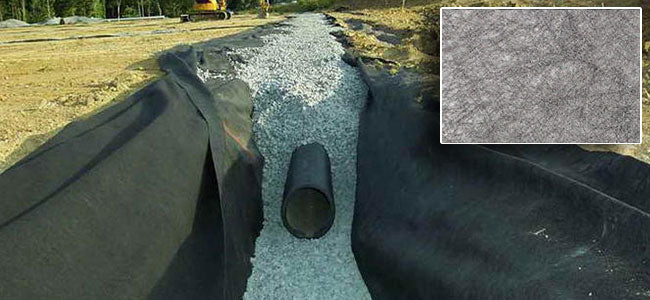
Drainage fabric — also called drainage filter fabric, drainage cloth, or geotextile filter fabric — is a permeable textile material placed between native soil and drainage aggregate (gravel, crushed stone, or pea gravel) in residential drainage systems. Its job is simple: let water through, keep soil out.
Without it, fine soil particles migrate into your drainage aggregate over time, filling the void spaces that water needs to move through. The result is a clogged system that backs up, floods, or fails entirely. Drainage fabric extends the functional life of any gravel-based drainage system from a few years to several decades.
The correct product for almost every residential yard drainage application is non-woven needle-punched geotextile. It is not the same as the woven landscape fabric sold at garden centers. We cover that distinction in detail in the section below.
French Drains
A french drain is a gravel-filled trench — typically containing a perforated pipe — that redirects groundwater and surface runoff away from problem areas. The fabric wraps the entire gravel-filled trench, separating it from the surrounding native soil on all four sides (bottom, both walls, and the top before backfilling).
Recommended Product
4 oz non-woven geotextile for standard residential soil. Step up to 6 oz if your yard has heavy clay content or persistent standing water.
Key Specs for French Drain Fabric
- AOS: US #40 to US #80 (0.18 mm to 0.43 mm) for most residential soils
- Permittivity: 1.0 sec⁻¹ or higher
- Grab tensile: 90 lbs or greater
- Roll width: wide enough to fully wrap the trench cross-section
How to Use It
Unfold the fabric into the empty trench so it drapes up both walls with 12-inch overlap flaps at the top on each side. Fill with washed gravel, lay the perforated pipe, top with more gravel, then fold the fabric flaps over the top before backfilling.
Drainage Swales
A drainage swale is a shallow, sloped channel designed to move surface water from one point to another. Swales come in two main forms: vegetated (grass-lined) and lined (gravel or rip-rap). Drainage fabric is relevant for lined swales only.
Vegetated Swales
Grass and native plant swales typically do not require drainage fabric. The plant root system stabilizes the soil, and the vegetation itself slows water flow and promotes infiltration. Adding fabric under a vegetated swale can actually impede plant establishment.
Lined Swales (Gravel or Rip-Rap)
When a swale is lined with gravel or large rip-rap stone for erosion protection, place a layer of non-woven geotextile fabric under the liner before placing stone. This prevents soil from migrating up through the stone layer (a phenomenon called "pumping") while still allowing water to infiltrate.
Recommended Product for Lined Swales
4 oz to 6 oz non-woven geotextile. Because swale fabric is subject to more hydraulic stress than buried french drain fabric, prioritize products with permittivity ratings above 1.5 sec⁻¹.
Dry Wells
A dry well is a buried pit filled with gravel or a prefabricated plastic chamber that collects surface runoff and allows it to slowly percolate into the surrounding soil. Without drainage fabric lining the pit, soil from the pit walls collapses inward over time, reducing storage capacity and blocking infiltration.
How Drainage Fabric Is Used in a Dry Well
Line the entire excavated pit with non-woven geotextile before adding gravel or installing the chamber. The fabric acts as a separator between the surrounding soil and the drainage aggregate, while still allowing water to pass through the pit walls and bottom into the native soil.
Recommended Product for Dry Wells
4 oz non-woven geotextile for most residential dry wells. The fabric needs to cover the full interior of the pit, so calculate your square footage based on pit perimeter, depth, plus the base area.
Dry Well Sizing Note
For large dry wells serving a significant catchment area, consult a drainage professional. Oversized dry wells in slow-draining soils can become saturated during heavy rain events if not properly sized.
Downspout Drainage Systems
Downspout drainage systems redirect roof runoff from gutters into the ground or to a discharge point away from the foundation. Common approaches include:
- Buried pipe systems: Corrugated or PVC pipe runs underground from the downspout to a discharge point. These do not typically require geotextile fabric unless they connect to a french drain or dry well.
- Downspout dry wells: The pipe terminates in a gravel-filled pit. Line with 4 oz non-woven geotextile as described above.
- Gravel-filled splash pad + infiltration: A gravel bed beneath and around the downspout area catches concentrated flow. Line the gravel bed with 4 oz non-woven geotextile to prevent soil migration under the gravel.
Use the Fabric Spec Finder to get a tailored recommendation based on your specific soil type, application, and volume requirements.
Open Spec Finder ›Application Comparison Table
French drain (loamy soil)
Fabric required: Yes | Weight: 4 oz non-woven | Placement: Wraps entire trench cross-section
French drain (clay soil)
Fabric required: Yes | Weight: 6 oz non-woven | Placement: Wraps entire trench cross-section
Vegetated swale
Fabric required: No | Weight: — | Placement: Not applicable
Gravel/rip-rap lined swale
Fabric required: Yes | Weight: 4–6 oz non-woven | Placement: Under liner, above native soil
Dry well (gravel fill)
Fabric required: Yes | Weight: 4 oz non-woven | Placement: Lines all interior pit surfaces
Downspout buried pipe
Fabric required: No (pipe only) | Weight: — | Placement: Not applicable
Downspout dry well
Fabric required: Yes | Weight: 4 oz non-woven | Placement: Lines pit as above
Downspout gravel splash pad
Fabric required: Yes | Weight: 4 oz non-woven | Placement: Under gravel pad
What NOT to Use: Common Mistakes
Several widely available products look similar to drainage fabric but are not appropriate for drainage applications.
Woven Polypropylene Landscape Fabric
The most common mistake. Woven landscape fabric is designed for weed suppression, not water filtration. Its tightly interlocked woven structure has a low flow rate that restricts water movement and clogs rapidly when fine particles accumulate on the surface. It will significantly degrade the performance of any drainage system.
Heavy Plastic Sheeting
Plastic sheeting (polyethylene film) is impermeable. It will redirect water, but does not filter it. Using plastic sheeting where drainage fabric is called for will prevent infiltration and can create hydrostatic pressure problems behind retaining walls or beneath structures.
Burlap or Jute
Organic materials like burlap decompose quickly when buried in moist soil. They are not appropriate for permanent drainage installations.
Shop Yard Drainage Fabric at Pro Fabric Supply
Non-woven geotextile in multiple weights and roll sizes — the right fabric for french drains, swales, dry wells, and downspout systems.
Shop Now ›Frequently Asked Questions
What is drainage fabric used for in a yard?
Drainage fabric (geotextile filter fabric) is used to separate native soil from drainage aggregate in french drains, dry wells, swales, and downspout systems. It prevents fine soil from clogging gravel, keeping drainage systems functional for decades.
What is the difference between drainage fabric and landscape fabric?
Landscape fabric is designed for weed suppression and has low water flow rates. Drainage fabric (non-woven geotextile) is engineered specifically for high permeability and filtration. Using landscape fabric in a drainage application will cause premature clogging and system failure.
Do I need fabric in a swale?
It depends. Vegetated grass swales do not require fabric since plant roots stabilize the soil. Lined swales with gravel or rip-rap do benefit from geotextile fabric placed under the liner to prevent soil migration through the aggregate.
How deep should drainage fabric be buried?
Drainage fabric should be placed at whatever depth your drainage system requires, typically 12 to 24 inches for french drains. The fabric does not require a minimum burial depth, but it should be fully covered to protect it from UV exposure and physical damage.
Can yard drainage fabric be overlapped?
Yes. When two pieces meet, overlap them by at least 12 inches to prevent gaps. In high-flow applications, an 18 to 24 inch overlap is recommended. Seams should be oriented so water flow pushes the top layer down onto the bottom layer, not up and apart.


