
Drainage Fabric: The Complete Guide to Geotextile Drainage Cloth
What drainage fabric is, how it works, and how to choose the right weight for your project
Drainage fabric — also called drainage cloth, drainage textile, or geotextile drainage fabric — is one of the most essential components of any French drain, retaining wall, drainage swale, or water management system. Without it, drainage systems clog prematurely, aggregate mixes with native soil, and water management performance degrades within a few years.
This guide explains exactly what drainage fabric is, how it works, the two critical functions it performs, how to select the right weight, and how to install it correctly in common drainage applications.
What Is Drainage Fabric?
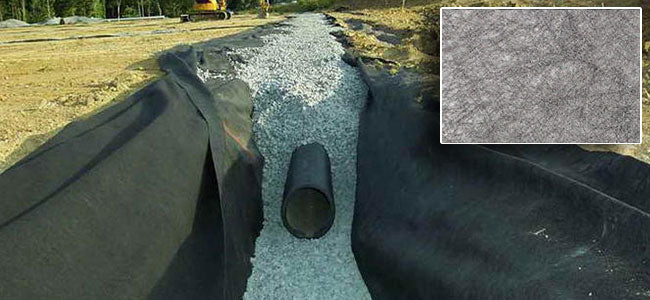
Drainage fabric is a permeable geotextile textile placed in drainage systems to allow water to flow freely through the system while filtering out fine soil particles (silt, clay, fine sand) that would otherwise migrate into and clog the drainage pipe, aggregate, or both.
The correct product for drainage applications is non-woven needle-punched polypropylene geotextile fabric. Unlike woven geotextile (which is used for structural reinforcement) or lightweight landscape fabric (which is for weed suppression), non-woven drainage fabric is engineered specifically for high water flow (permittivity) combined with effective soil particle filtration.
You may see drainage fabric called by many names: drainage cloth, drainage textile, drainage filter fabric, geotextile drainage fabric, drainage and filtration fabric, or simply filter fabric. All of these names refer to the same type of product when used in drainage applications.
The Two Jobs of Drainage Fabric
Drainage fabric performs two critical functions in any drainage system:
Job 1: Filtration — Keeping Fine Particles Out
As groundwater moves toward a drainage system, it carries fine soil particles — silt, clay, fine sand — that it picks up as it flows through the soil. Without a filter barrier, these particles enter the drainage aggregate, fill the pore spaces, and eventually clog the system entirely. The perforated pipe inside a clogged drain is useless.
Drainage fabric's primary filtration job is to allow water through while trapping these fine particles. The dense pore structure of non-woven needle-punched geotextile is ideal for this — the random fiber matrix creates millions of very small pores that filter fine particles while maintaining high water flow rates.
Job 2: Separation — Keeping Soil and Aggregate Apart
In any drainage system, drainage aggregate (washed gravel, crushed stone) sits next to or within native soil. Over time — with wetting, drying, traffic, and freeze-thaw cycles — soil migrates up into the aggregate layer, reducing its void space and drainage capacity.
Drainage fabric acts as a permanent separator, keeping native soil in place below and beside the aggregate, and keeping the aggregate clean and functional for the life of the drainage system. A well-installed drainage fabric can extend the functional life of a drain significantly compared to an unprotected installation.
Types of Drainage Fabric
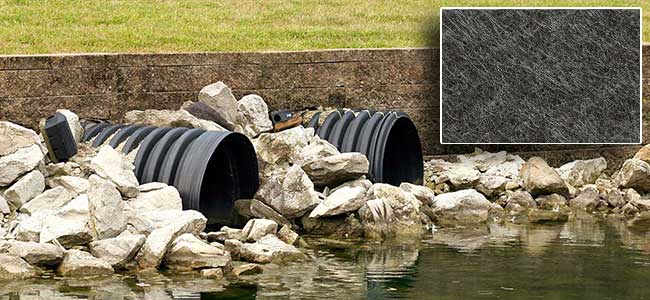
Non-Woven Needle-Punched Geotextile (Recommended for Drainage)
This is the standard drainage fabric for all drainage applications. Dense, felt-like structure with high permittivity and excellent filtration. Available in weights from 4oz through 32oz per square yard. This is the product sold by Pro Fabric Supply.
Woven Geotextile (Not Recommended for Drainage)
Woven geotextile has a regular grid structure with larger openings that can pass fine particles in drainage applications. It is used for structural reinforcement (roads, driveways) — not for drainage and filtration. Do not use woven geotextile where filtration is required.
Lightweight Landscape Fabric (Not Suitable for Drainage)
Consumer-grade landscape fabric (sold at hardware stores) is not an acceptable substitute for geotextile drainage fabric. It is too light, too weak, and not manufactured to drainage engineering standards. It will fail rapidly in drainage applications, typically clogging within 1–3 years.
Selecting the Right Drainage Fabric Weight
Weight determines strength, durability, and the degree of filtration. Heavier fabrics are thicker and stronger but slightly less permeable. Here is how to match weight to application:
4oz
Best for: French drains, garden drainage, drainage swales, retaining wall drainage (light)
Why: Highest permittivity, lightest weight, easiest to work with — ideal for most residential drainage
Shop 4oz →7oz
Best for: Standard drainage systems, moderate drainage loads, agricultural drainage
Why: More durable than 4oz while maintaining good water flow — good for heavier drainage
Shop 7oz →8oz
Best for: Heavy-duty drainage, drainage under aggregate loads, combined drainage and erosion
Why: Needle-punched for uniform performance; significantly stronger than 4–7oz
Shop 8oz →10–12oz
Best for: Commercial drainage systems, heavy aggregate placement
Why: High puncture resistance for drainage under heavy aggregate loading
Shop 10oz → | Shop 12oz →For most residential drainage applications — French drains, garden drainage, retaining wall drainage — 4oz is a common choice. Step up to 7oz or 8oz when drainage aggregate is heavy, when traffic loads are significant, or when the application combines drainage with erosion control.
Drainage Applications
French Drains
The most common use for drainage fabric. The fabric lines the trench, encasing the perforated pipe and drainage gravel in a geotextile "sock" that filters groundwater before it enters the pipe. Without fabric, French drains clog much faster. With fabric, they last significantly longer. Recommended: 4oz for residential French drains.
Retaining Wall Drainage
Drainage fabric is placed behind retaining walls to filter water from the retained soil and channel it to weep holes or drainage aggregate. Prevents hydrostatic pressure buildup — a leading cause of retaining wall failure. Recommended: 4oz – 8oz.
Drainage Swales
In drainage swales and channels, drainage fabric lines the base and sides to filter water entering the swale from surrounding soil, preventing siltation that would reduce channel capacity over time.
Garden & Landscape Drainage
Lightweight 4oz drainage fabric under garden paths, patio bases, raised beds, and decorative stone allows water to drain freely while preventing soil from migrating up into the stone layer — keeping stone clean and pathways level over time.
Agricultural Drainage
In tile drain systems and surface drainage applications, drainage fabric filters soil particles from drainage water, protecting tile drain pipes and maintaining field drainage capacity. 7oz – 10oz weights are typical for agricultural applications.
Drainage Fabric Installation Tips
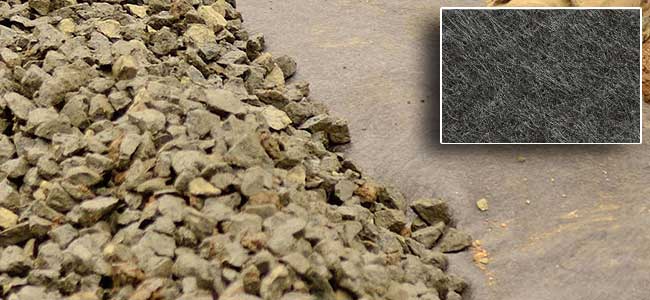
Follow these installation principles for best results:
- 1 Overlap seams by 12+ inches. When two pieces of drainage fabric meet, overlap by at least 12 inches to prevent soil from finding a path through seam gaps. Secure overlaps with landscape staples or weight from aggregate.
- 2 Run fabric up trench walls. In French drains and drainage trenches, run the fabric all the way up the trench walls and over the top — completely encasing the aggregate and pipe in fabric, with no exposed soil contact zones.
- 3 Size the fabric before cutting. Measure the trench width + depth × 2 + 12 inches for overlap on each side. For a 12-inch wide × 18-inch deep trench: 12 + (18×2) + 24 = 72 inches of fabric width needed.
- 4 Avoid wrinkles and bridging. Press the fabric firmly into the trench corners and against trench walls. Bridging (fabric suspended across a corner without contact) can reduce filtration effectiveness and allow aggregate to punch through.
- 5 Install before aggregate placement. Always lay drainage fabric before placing aggregate. Trying to slip fabric under existing aggregate is ineffective.
- 6 Protect from prolonged UV exposure. UV-stabilized drainage fabric is designed for temporary UV exposure during installation. Cover with aggregate or soil within 30 days for best longevity.
Drainage Fabric Products
Pro Fabric Supply non-woven geotextile drainage fabric is available in commercial roll sizes. All orders ship free.
- 4oz Non-Woven Drainage Fabric — 12.5'×360' and 15'×360' rolls
- 7oz Non-Woven Drainage Fabric — 15'×300' rolls
- 8oz Non-Woven Drainage Fabric — 12.5'×360' and 15'×300' rolls
- 10oz Non-Woven Drainage Fabric — 12.5'×360' and 15'×300' rolls
- 12oz Non-Woven Drainage Fabric — 12.5'×360' and 15'×300' rolls
Not Sure Which Drainage Fabric Is Right?
Use our Fabric Selector Tool for a personalized recommendation. Free shipping on all orders.
Use the Fabric Selector Shop All Drainage FabricFrequently Asked Questions About Drainage Fabric
What is drainage fabric?
Drainage fabric is non-woven needle-punched polypropylene geotextile used in drainage systems to allow water to pass through while filtering fine soil particles that would clog the drainage aggregate or pipe. It performs both filtration and separation functions, extending the functional life of French drains, retaining wall drainage, and other drainage systems.
Is drainage cloth the same as drainage fabric?
Yes — drainage cloth, drainage fabric, drainage textile, and drainage filter fabric all refer to the same material: permeable non-woven geotextile used in drainage applications. These terms are used interchangeably in the construction and landscaping industries.
Do I really need drainage fabric in a French drain?
Yes. French drains installed without drainage fabric clog significantly faster as fine soil particles migrate into the drainage aggregate and pipe. With drainage fabric, a properly installed French drain will remain functional far longer than one without it.
What is the difference between drainage fabric and landscape fabric?
Drainage fabric is a heavy-duty engineered geotextile (4oz–32oz) designed for high water flow and effective filtration. Landscape fabric is a lightweight consumer product designed for weed suppression only. Landscape fabric should never be used as a substitute for geotextile drainage fabric — it clogs quickly, fails structurally, and does not provide effective soil filtration.
Can drainage fabric be used in retaining walls?
Yes — drainage fabric is a critical component of properly built retaining walls. It is installed behind the wall face (between the retained soil and drainage aggregate) to filter water from the soil and direct it to weep holes or drainage pipes. Without drainage fabric in a retaining wall, hydrostatic pressure from water-saturated retained soil can push the wall over. Recommended weight: 4oz – 8oz.
What size rolls does drainage fabric come in?
Pro Fabric Supply drainage fabric is available in commercial roll sizes including 12.5-foot and 15-foot widths, with lengths ranging up to 360 feet depending on weight. These commercial sizes are ideal for both small residential French drains and large commercial drainage projects. All orders ship free.


